The UK’s public markets represent a powerful engine, uniquely positioned to drive British economic growth.
This June, the Quoted Companies Alliance welcomed almost 250 members from the financial market community, to our Annual Conference 2026, under the ambitious banner ”Scaling for Success.”
The day served as a vital launchpad for actionable solutions, focusing on how to maximise capital allocation, optimise regulatory frameworks, and harness innovations like AI to streamline corporate reporting. Bringing together senior politicians, regulators, and industry leaders, the event sought to establish a clear, forward-looking roadmap to ensure our scaling small and mid-caps receive the domestic backing they need to thrive.

“If only every day was like this one where growth companies come first,” James Ashton, the QCA’s CEO, said in his opening remarks. He set out a direct challenge to London’s giant asset managers to back UK growth. “If the UK is really going for growth, it starts with our companies, many of them in this room,” he said. “Small cap stocks are just large caps with their best years ahead of them.”
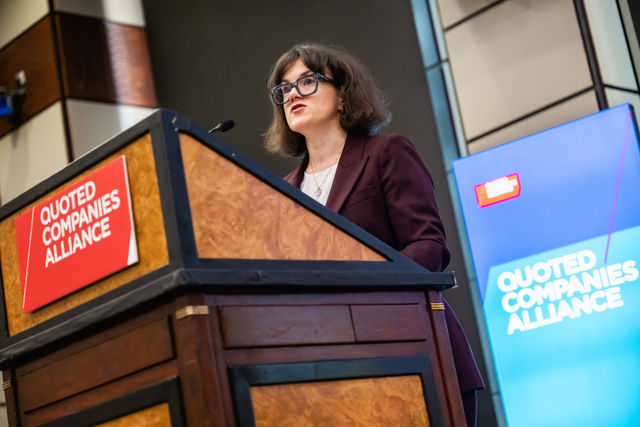
In her keynote, City Minister Rachel Blake responded directly to Ashton’s challenge, highlighting the government’s commitment to ensuring more capital reaches companies that are scaling — “particularly the quoted small and midcaps that can drive productivity and innovation across the country.”

”The UK is the best place in the world to build and finance growth companies. But to maintain our position, we must champion our success stories, be relentlessly practical about what needs to change, and disciplined about turning reforms into outcomes.
Rachel Blake MPEconomic Secretary to the Treasury
Panel Discussion: Channelling Capital into the Companies that Matter

The discussion, chaired by Judith MacKenzie of Downing Fund Managers, brought together Nemone Wynn-Evans of LGPS Central, Kate Jones of the Pension Protection Fund, Ashok Gupta of New Capital Consensus, and Nicholas Clark, Chief Executive of Built Cybernetics.
The Mansion House Accord commits major DC pension providers to allocate 10% of their default funds to private markets by 2030, with 5% directed to unlisted UK equity. The gap between that ambition and company-level reality was a recurring theme. Clark was candid about the gap between policy ambition and company-level reality: “I’m not aware of any AIM companies that have had any money from Mansion House.”
The QCA has been actively engaging with HMT and DWP on how smaller public companies can benefit.
Gupta argued the root cause was structural, the UK’s £6 trillion of savings trapped in a passive mindset. “Everybody in the system is behaving sensibly and doing what they have been asked to do. But when you look at where the money has been sent, it has been sent to the wrong places,” he added. But institutional investors on the panel signalled genuine intent to allocate as reforms bed in.
A key theme to emerge from the discussion was this: the money exists and with the right resolve, it can reach the businesses that need it most.
Fireside Chat: Sheldon Brown interviews Andrew Griffith MP

Andrew Griffith, Shadow Secretary of State for Business and Trade, praised the QCA as “one of the best interlocutors I had when I was city minister” and argued that stability was what businesses needed most right now.
On retail investment, he called for removing friction from ISAs and restoring individual accountability for financial decisions.
Panel Discussion: Scaling in Public — What’s Still Missing to Get Growth Going?

Marcus Stuttard of the London Stock Exchange welcomed the AIM rules consultation published that morning, a meaningful step toward giving AIM a more proportionate regulatory framework. Steven Fine of Peel Hunt argued the pipeline of great UK companies was there, the missing ingredient was a domestic investor base willing to back them. Rakesh Shaunak of MHA, whose firm’s shares are up 50% since float, urged companies to back themselves and tell their story with conviction. Eva Barboni of Enterprise Britain called for a cultural shift, championing British success rather than talking it down.
The panel agreed the direction of travel was right and that momentum depends on domestic capital finding the confidence to back British growth companies.
Fireside Chat: James Ashton interviews Mark Austin

Mark Austin, chair of the Dematerialisation Market Action Taskforce, confirmed the first step of eliminating paper share certificates is on track, with a first report due at Mansion House in July and a target date of 4 January 2028. He also reassured the audience that section 793 is not under threat. The QCA will be invited to represent small-cap issuers as the taskforce moves into steps two and three — this will guarantee that smaller listed businesses will have a direct seat at the table when the new digital infrastructure is built.
Panel Discussion: Turning the Page on Excessive Corporate Reporting

Chaired by Ruth Sunderland, the panel brought together Professor Ken Lee of Loughborough Business School, Dr Michelle de Jongh of Inspired ESG, Brad Ormsby of Judges Scientific and Linda Timson of the Department for Business and Trade. Ormsby, whose audit fee has risen 300% in five years, was blunt: the reporting burden had become a direct cost to shareholders. Timson was clear: only genuine reform, not minor adjustments, would make the difference. Lee noted that annual reports are already being read primarily by machines, and that companies should write accordingly.
Corporate reporting has become a burden that costs companies more than it delivers. For smaller quoted companies, the government’s review cannot come soon enough.

Richard Moriarty, Chief Executive of the Financial Reporting Council, was clear: businesses, not regulators, generate growth. He announced an expansion of the FRC’s programme of working directly with smaller companies to right-size their reports.
Ultimately, the conference demonstrated that the pathway to a revitalised capital market is well within our collective reach. By converting voluntary pension commitments into tangible investments, right-sizing the reporting burden, and backing the QCA’s call for a £1 billion British Business Bank allocation, the UK can create an unrivalled environment for business growth.
As QCA Chair Sangita Shah noted in her closing remarks, it is time to move past a narrative where small-caps are treated like the “neglected middle child” of the financial ecosystem. Instead, she urged a profound cultural shift: “I say back Britain. We are more than just a productive asset on a screen—we are real individuals injecting growth into local communities.” The strategic intent across the industry is growing; now is the moment for the UK’s financial ecosystem to act with urgency, change its risk appetite, and fully bank on British success.